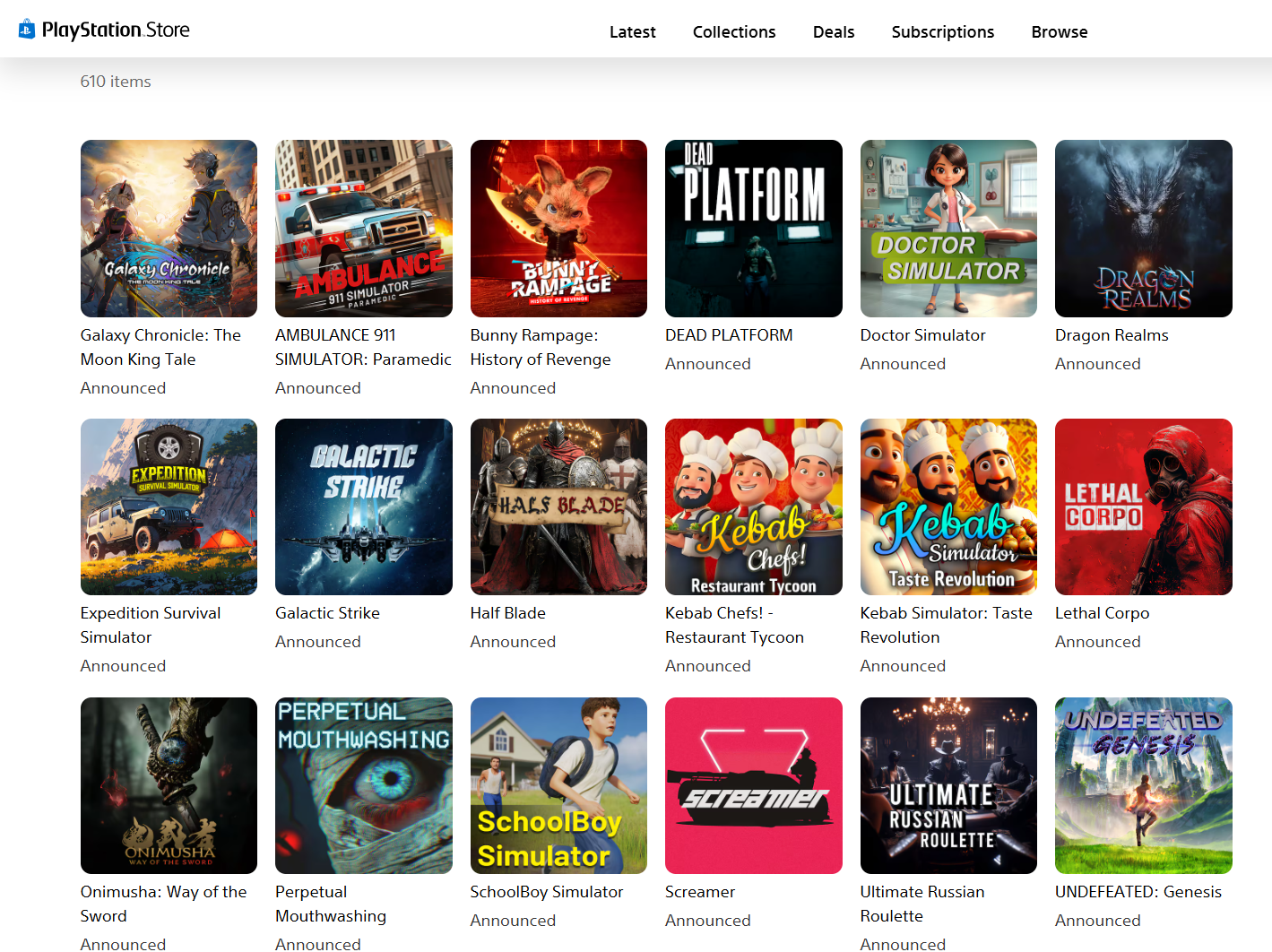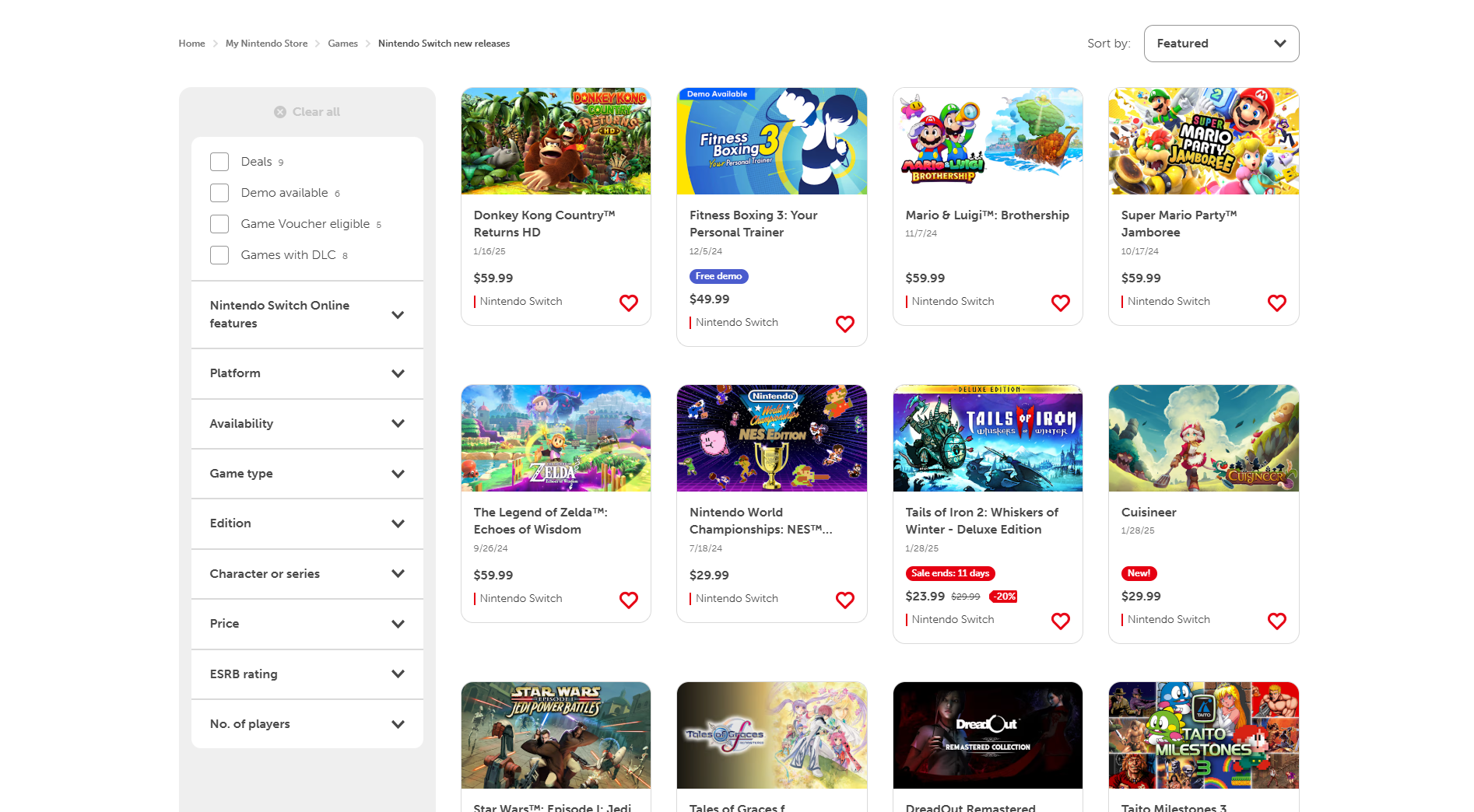
In recent months, a peculiar issue has emerged on the PlayStation Store and Nintendo eShop, with users dubbing the influx of low-quality, misleading games as "slop." Both Kotaku and Aftermath have shed light on this growing concern, particularly noting how the eShop is increasingly filled with games that use generative AI and deceptive store pages to trick consumers into buying substandard products. This trend has also begun to affect the PlayStation Store, notably cluttering the "Games to Wishlist" section with unusual offerings.
These "slop" games are not simply poor quality; they represent a flood of similar-looking games that are overshadowing other content on the storefronts. Typically, these are simulation games that are perpetually on sale, often mimicking themes from popular titles or even directly copying their names and concepts. They frequently feature hyper-stylized art and screenshots that suggest the use of generative AI, yet in reality, these games often suffer from poor controls, technical issues, and a lack of engaging content.
The issue is compounded by the fact that these games are produced en masse by a small number of companies, which are notoriously difficult to track down and hold accountable. As YouTube creator Dead Domain discovered, these companies often lack transparent public information and may even change their names to evade scrutiny.
The outcry from users has grown louder, calling for better regulation of these storefronts to curb the "AI slop" problem. This is particularly urgent given the reported performance issues with Nintendo's eShop, which seems to be slowing down as more games flood its pages.
To understand how these games end up on these platforms, I spoke with eight individuals in game development and publishing, all of whom wished to remain anonymous due to concerns about platform holder reprisals. Their insights helped clarify the process of getting a game onto Steam, Xbox, PlayStation, and Nintendo Switch, shedding light on why some stores are more affected by "slop" than others.
The Magical World of Cert
The process of releasing a game on any of these four major storefronts begins with a developer or publisher pitching to Nintendo, Sony, Microsoft, or Valve for access to development tools and backend portals. Following this, they complete detailed forms about the game's features and technical requirements. The game then undergoes a certification (or "cert") process, where the platform holder checks for compliance with specific technical requirements, legal standards, and age ratings. This process is not a quality assurance check but rather ensures that the game meets the platform's technical and legal standards.
If a game passes certification, it can be released. If it fails, the developer must address the issues and resubmit. However, obtaining clear feedback from platform holders on why a game was rejected can be challenging, with Nintendo being particularly noted for its lack of detailed explanations.
Front and Center
Platform holders also review store page content, requiring developers to use screenshots that accurately represent their games. However, the review process primarily checks for competing imagery and correct language, not the accuracy of the game representation itself. For instance, one game had to resubmit screenshots after submitting PC images that were not feasible for the Nintendo Switch.
Nintendo and Xbox review all changes to store pages before they go live, while PlayStation conducts a single check near launch. Valve reviews the store page before it goes live but does not monitor subsequent changes. This lack of ongoing review allows developers to alter store pages post-approval, potentially leading to misleading content.
While platform holders do check if the product matches the game description, the standards for accuracy are loosely defined, allowing some games to slip through. Misleading screenshots typically result in a request to remove the content rather than severe penalties, unless the developer risks being delisted or removed as an approved developer.
Notably, none of the console storefronts have specific rules against using generative AI in games or store assets, though Steam does ask developers to disclose its use without limiting it.
Eshop to eslop
The reasons behind the flood of "slop" games on Sony and Nintendo's platforms, compared to the relative immunity of Xbox, stem from their approval processes. Microsoft approves games on a per-game basis, making it harder for low-quality games to proliferate. In contrast, Nintendo, Sony, and Valve approve developers or publishers, allowing them to release multiple games after initial approval, as long as they pass certification.
Some developers exploit this by releasing bundles and setting long discounts, ensuring their games remain at the top of new releases and discount lists, overshadowing other games. This issue is exacerbated by automatic lists on consoles, which can be overwhelmed by low-quality games, pushing genuine efforts down the rankings.
While generative AI is often blamed for the "slop" problem, it's not the sole issue. Many games use generic concept art, and the games themselves are still developed by people. Xbox, despite being less affected by "slop," is noted for its investment in generative AI, suggesting it may be less likely to discourage its use in the future.
Discoverability also plays a significant role in how these games impact users. Xbox and PlayStation use curated store pages, making it harder for users to stumble upon "slop" games. However, PlayStation's "Games to Wishlist" tab, sorted by release date, can still surface these games prominently. Steam, despite having a large volume of potential "slop," benefits from robust sorting and search options, diluting the impact of these games. Nintendo's approach, however, is to throw all new releases into an unsorted pile, making the problem more visible.
All Games Allowed
Users have been urging Nintendo and Sony to improve their storefront regulation to combat the "slop" problem. However, neither company responded to requests for comment on potential solutions. Developers and publishers are skeptical about significant changes, especially from Nintendo, with some suggesting minimal improvements might come with the Nintendo Switch 2. Sony has previously taken action against similar issues, such as in 2021 when it cracked down on repetitive content designed for trophy hunters.
There is a debate about whether aggressive platform regulation is the answer. Initiatives like Nintendo Life's "Better eshop" faced backlash for mistakenly categorizing legitimate indie games as shovelware or asset flips. Overly aggressive filters could harm quality games, and developers fear that platform holders might inadvertently target legitimate software in their efforts to curb "slop."
Ultimately, the challenge lies in balancing the allowance of all games with preventing cynical cash grabs. Platform holders, staffed by individuals, must navigate this complex landscape, striving to differentiate between genuine projects and exploitative content.